

Lubricant Packaging Market Forecast Outlook 2026-2036: Market to Reach USD 22.8 Billion by 2036 at 3.9% CAGR
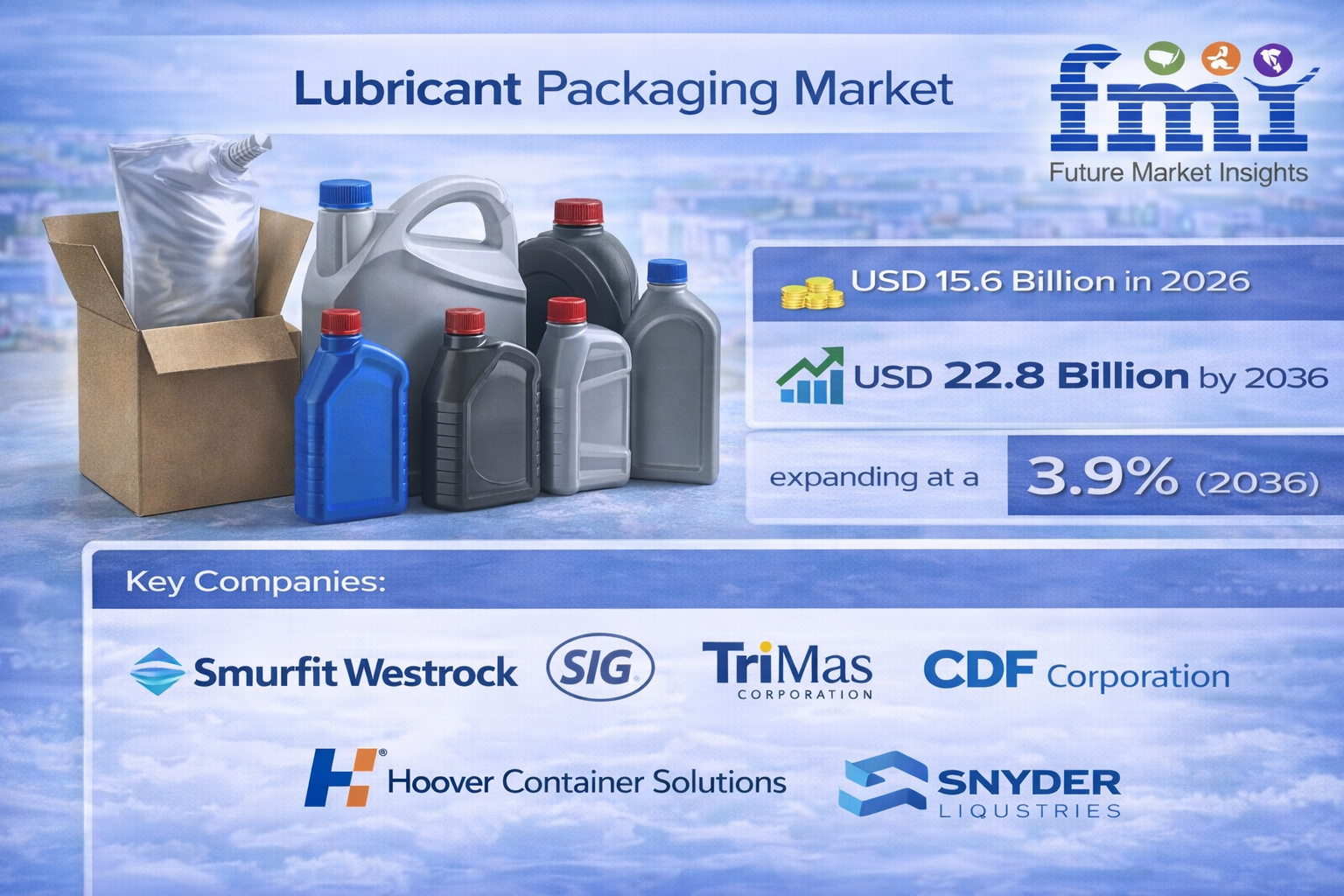
Lubricant Packaging Market
The global lubricant packaging market is estimated at USD 15.6 billion in 2026 and is projected to reach USD 22.8 billion by 2036.
NEW YORK, DE, UNITED STATES, February 24, 2026 /EINPresswire.com/ -- The Lubricant Packaging Market is estimated at USD 15.6 billion in 2026 and is projected to reach USD 22.8 billion by 2036, expanding at a CAGR of 3.9% during the forecast period. According to Future Market Insights (FMI), growth will be driven less by lubricant consumption alone and more by formulation complexity, industrial expansion, logistics requirements, and regulatory compliance pressures.
As lubricant markets diversify across automotive, industrial, energy, and specialty applications, the Lubricant Packaging Market is evolving from passive containment toward engineered systems that support chemical resistance, leak prevention, safe handling, and supply-chain reliability.
• Market size in 2026 USD 15.6 billion
• Market size by 2036 USD 22.8 billion
• CAGR (2026–2036) 3.9%
• Leading packaging type (2026) Bottles (29.6% share)
• Leading packaging material Plastic (67.4% share)
• Largest regional share East Asia
• Fastest-growing country India (5.6% CAGR)
• Key companies Smurfit Westrock; SIG; TriMas Corporation; CDF Corporation; Liquibox; Others
Market Momentum (2026–2036 Value Path):
The Lubricant Packaging Market begins the forecast period at USD 15.6 billion in 2026, supported by steady demand from automotive OEMs, aftermarket distributors, and industrial users. By 2036, the market is projected to reach USD 22.8 billion, reflecting steady structural expansion across bulk and retail formats. Growth is reinforced by increasing vehicle parc size, industrial machinery deployment, infrastructure development, and energy production across emerging economies.
FMI modeling integrates lubricant consumption volumes, packaging penetration rates, material substitution trends, and sustainability-driven material optimization to project long-term demand through 2036.
Why the Lubricant Packaging Market Is Growing:
Three structural drivers are elevating the Lubricant Packaging Market:
1. Formulation Complexity: Synthetic engine oils, metalworking fluids, specialty greases, and high-performance industrial lubricants require chemical-resistant and contamination-proof packaging.
2. Industrial & Infrastructure Expansion: Construction, mining, agriculture, power generation, and heavy transport sectors are increasing bulk lubricant usage, driving adoption of drums, pails, jerry cans, and intermediate bulk containers (IBCs).
3. Transport Safety & Leak Prevention: Regulatory scrutiny on hazardous and environmentally sensitive fluids demands packaging systems capable of withstanding stacking, vibration, temperature variation, and long-distance logistics.
FMI expects packaging to transition into a strategic enabler of regulatory compliance and product performance.
Get Access of Report Sample: https://www.futuremarketinsights.com/reports/sample/rep-gb-4228
Segment Spotlight
• Bottles Lead Packaging Type (29.6% Share): Bottles represent 29.6% of total demand in 2026, dominating automotive and consumer lubricant applications. Their flexibility in size, ergonomic design, and compatibility with retail distribution make them ideal for engine oils, transmission fluids, and specialty lubricants. Bottles also align with automated filling and labeling systems, reinforcing cost efficiency and production scalability.
• Plastic Dominates Material Segment (67.4% Share): Plastic holds 67.4% of total market share, supported by lightweight properties, chemical resistance, impact durability, and cost advantages over metal alternatives. High-density polyethylene (HDPE), polypropylene (PP), and PET remain dominant across bottles, drums, and IBCs. Plastic packaging supports recyclability initiatives, lightweighting strategies, and material optimization while maintaining leak resistance and performance integrity.
• Bulk Industrial Formats Reinforce Market Stability: Drums, barrels, pails, jerry cans, bag-in-box systems, and intermediate bulk containers remain essential for industrial and energy-sector lubricant handling. These formats ensure safe storage, contamination prevention, and operational efficiency in large-scale applications.
Drivers, Opportunities, Trends, Challenges
• Drivers: Regulatory oversight by the USA Environmental Protection Agency (EPA), Department of Transportation (DOT), and Occupational Safety and Health Administration (OSHA) reinforces demand for leak-resistant, compliant packaging systems. Improper handling and leakage risks elevate the importance of secure containers and spill prevention mechanisms.
• Opportunities: Flexible and semi-rigid packaging formats such as bag-in-box and spouted pouches offer material efficiency and logistics optimization. Expansion of non-food liquid packaging expertise into lubricant applications is creating cross-sector innovation.
• Trends: Lightweighting, recyclable plastics, reusable bulk packaging, and downgauging are reshaping material selection. Improved dispensing systems and tamper-evident closures are enhancing safety and user convenience.
• Challenges: Steel price volatility, hazardous goods compliance costs, and regulatory complexity increase capital requirements. Suppliers must balance performance integrity with sustainability targets and cost control.
Competitive Landscape
• The Lubricant Packaging Market is increasingly defined by functional innovation, flexible packaging expansion, and material efficiency strategies.
• Key players include Smurfit Westrock; SIG; TriMas Corporation; CDF Corporation; Liquibox; and others.
Recent strategic developments include:
• March 2025: SIG expanded bag-in-box capabilities for non-food industrial liquids, including lubricants.
• January 2025: Liquibox reinforced its global focus on industrial liquid packaging for lubricant and chemical applications.
Competition is shifting toward engineering capability, lifecycle efficiency, sustainability alignment, and application-specific design rather than price alone.
FAQ
What will the Lubricant Packaging Market be worth by 2036?
USD 22.8 billion.
What is the projected CAGR?
3.9% from 2026 to 2036.
Which packaging type leads?
Bottles, with 29.6% share in 2026.
Which material dominates?
Plastic packaging, with 67.4% share.
Which region holds the largest share?
East Asia.
Which country is growing fastest?
India at 5.6% CAGR.
Why FMI: https://www.futuremarketinsights.com/why-fmi
Have a Look at Related Research Reports on the Packaging Domain:
BOPP Laminated Woven Sacks Market: https://www.futuremarketinsights.com/reports/bopp-laminated-woven-sacks-market
Packaging Tubes Market Share Analysis: https://www.futuremarketinsights.com/reports/packaging-tubes-market-share-analysis
Tube Laminating Films Market Share Analysis: https://www.futuremarketinsights.com/reports/tube-laminating-films-market-share-analysis
About Future Market Insights (FMI)
Future Market Insights, Inc. (FMI) is an ESOMAR-certified, ISO 9001:2015 market research and consulting organization, trusted by Fortune 500 clients and global enterprises. With operations in the U.S., UK, India, and Dubai, FMI provides data-backed insights and strategic intelligence across 30+ industries and 1200 markets worldwide.
Sudip Saha
Future Market Insights Inc.
+1 347-918-3531
email us here
Legal Disclaimer:
EIN Presswire provides this news content "as is" without warranty of any kind. We do not accept any responsibility or liability for the accuracy, content, images, videos, licenses, completeness, legality, or reliability of the information contained in this article. If you have any complaints or copyright issues related to this article, kindly contact the author above.
