

Bioplastics for Packaging Market Forecast 2026-2036: Global Market to Reach USD 39.5 Billion by 2036 at 9.8% CAGR
Bioplastics For Packaging Market
Bioplastics for packaging market to reach USD 39.5 billion by 2036, growing at a 9.8% CAGR, driven by rising demand for sustainable packaging solutions.
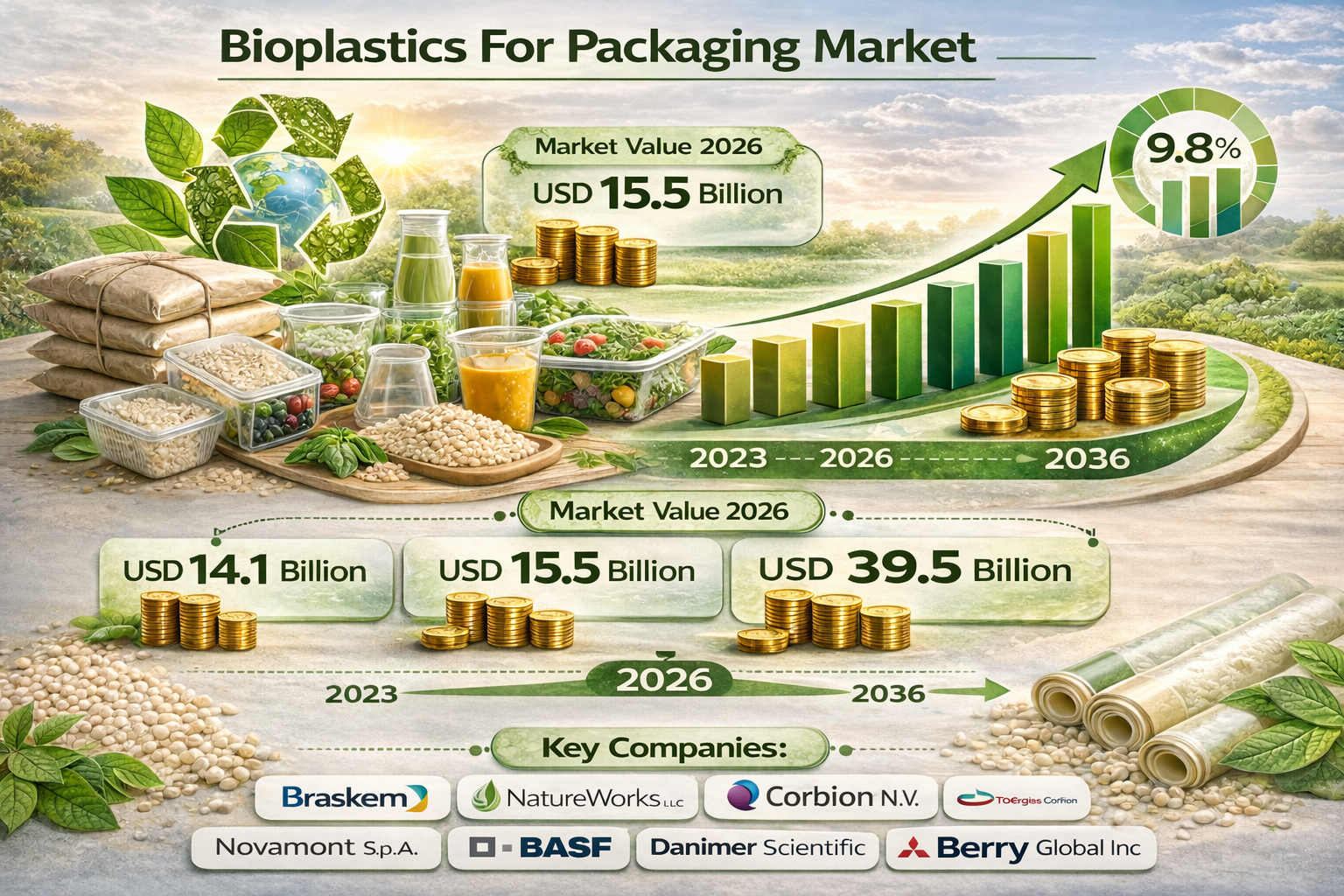
NEW YORK, DE, UNITED STATES, February 25, 2026 /EINPresswire.com/ -- The Bioplastics for Packaging Market was valued at USD 14.1 billion in 2025 and is projected to reach USD 39.5 billion by 2036, expanding at a CAGR of approximately 9.8% during the forecast period. Demand is estimated to rise to USD 15.5 billion in 2026, reflecting strong structural momentum.
An absolute dollar growth of USD 22.0 billion over the decade signals transformational expansion driven by single-use plastic bans, corporate net-zero commitments, and consumer demand for sustainable packaging. Despite higher production costs compared to fossil-based plastics and feedstock constraints, technology scaling and strategic partnerships continue to accelerate commercialization.
• Market size in 2025 USD 14.1 billion
• Market size in 2036 USD 39.5 billion
• CAGR (2026–2036) Approximately 9.8%
• Leading material segment Bio PET (38.6% share in 2026)
• Leading application segment Bottles (44.2% share in 2026)
• Top end-use segment Food & Beverages (52.7% share)
• Fastest-growing countries India (10.9%) and China (10.5%)
• Key companies Braskem S.A.; NatureWorks LLC; Corbion N.V.; TotalEnergies Corbion; Novamont S.p.A.; BASF SE; Danimer Scientific; Mitsubishi Chemical Group; Berry Global Inc.; Amcor Plc
Market Momentum (YoY Path):
The Bioplastics for Packaging Market begins at USD 14.1 billion in 2025, advancing to USD 15.5 billion in 2026 as regulatory compliance programs accelerate material substitution. By 2028, portfolio conversions in beverage and flexible packaging formats strengthen volume penetration. Through 2030 and 2031, certification-led procurement and mass-balance accounting frameworks drive sustained adoption across food and personal care segments. By 2033, performance validation of PLA, PHA, and drop-in polymers expands high-barrier applications. Ultimately, the market reaches USD 39.5 billion in 2036, reflecting mainstream integration across rigid and flexible packaging lines.
Why the Market is Growing:
Growth in the Bioplastics for Packaging Market is anchored in regulatory mandates targeting single-use plastics. Governments across Asia Pacific and Europe are enforcing compostability certification requirements and recyclability-by-design standards. Corporate sustainability roadmaps are accelerating conversion toward bio-based and biodegradable materials, particularly in bottles and flexible packaging. Consumer preference for low-carbon, compostable, and circular packaging further supports premium positioning. Food & beverage packaging remains the primary growth engine, accounting for 52.7% share, as beverage brands deploy visible bottle rollouts aligned with decarbonization milestones.
Get Access of Report Sample: https://www.futuremarketinsights.com/reports/sample/rep-gb-6087
Segment Spotlight
1) Material: Bio PET (38.6%): Bio PET is projected to hold 38.6% share in 2026. Its compatibility with existing PET recycling infrastructure, mechanical strength, transparency, and barrier performance allow seamless integration into established conversion lines. Commercial bio-paraxylene initiatives and large-scale bottle programs demonstrate its scalability advantage.
2) Application: Bottles (44.2%): Bottles dominate with 44.2% share in 2026. Beverage packaging rewards materials combining processability, durability, and recyclability alignment. Bio-based PET bottle introductions, including large-scale rollouts in Japan, highlight bottle formats as primary adoption vehicles for bioplastics.
3) End Use: Food & Beverages (52.7%): The food & beverages segment commands 52.7% share. Regulatory compliance, shelf-life requirements, and brand-led carbon reduction programs drive material substitution in beverage bottles, trays, films, and compostable formats.
Drivers, Opportunities, Trends, Challenges:
• Drivers: Single-use plastic bans, EPR mandates, and landfill diversion targets are transitioning sustainability from voluntary initiatives to compliance baselines. Regulatory frameworks accelerate adoption of certified compostable and bio-based polymers.
• Opportunities: Circular premiumization is reshaping procurement strategies. Certified circular content, mass-balance accounting, and drop-in feedstocks provide compatibility advantages. Portfolio-based approaches matching material to application enhance scalability.
• Trends: Growth is shifting toward performance-validated materials compatible with existing conversion lines. PLA and PHA innovations expand compostable packaging options, while marine-degradable polymers address niche environmental concerns.
• Challenges: Higher price-per-unit compared to fossil plastics, feedstock competition, and agricultural dependency create cost pressures. Food-grade approvals, migration testing, and certification requirements delay entry for smaller suppliers.
Competitive Landscape
The Bioplastics for Packaging Market remains innovation-intensive, but scalable competition is concentrated among suppliers with global certification capabilities and multi-continent production.
Key players include:
• Braskem S.A.
• NatureWorks LLC
• Corbion N.V.
• TotalEnergies Corbion
• Novamont S.p.A.
• BASF SE
• Danimer Scientific
• Mitsubishi Chemical Group
• Berry Global Inc.
• Amcor Plc
Recent developments include Amcor and Berry Global’s announced all-stock merger to strengthen sustainable packaging portfolios, and UFlex’s patent for a sustainable waterborne heat seal coating designed for food and consumer packaging. Suppliers that ensure feedstock security, food-grade approvals, and compatibility with existing recycling systems retain structural advantage.
FAQ :
What is the projected size of the Bioplastics for Packaging Market by 2036?
The market is expected to reach USD 39.5 billion.
What is the forecast CAGR?
Approximately 9.8% from 2026 to 2036.
Which material leads the market?
Bio PET leads with 38.6% share in 2026.
Which application dominates?
Bottles hold 44.2% share in 2026.
Which end-use sector drives demand?
Food & Beverages account for 52.7% share.
Why FMI: https://www.futuremarketinsights.com/why-fmi
Have a Look at Related Research Reports on the Packaging Domain:
Biodegradable Packaging Market Share Analysis: https://www.futuremarketinsights.com/reports/biodegradable-packaging-market-share-analysis
Biopolymer Closure Market: https://www.futuremarketinsights.com/reports/biopolymer-closure-market
Plant-Based Bioplastic Shrink Packaging Market: https://www.futuremarketinsights.com/reports/plant-based-bioplastic-shrink-packaging-market
About Future Market Insights (FMI)
Future Market Insights, Inc. (FMI) is an ESOMAR-certified, ISO 9001:2015 market research and consulting organization, trusted by Fortune 500 clients and global enterprises. With operations in the U.S., UK, India, and Dubai, FMI provides data-backed insights and strategic intelligence across 30+ industries and 1200 markets worldwide.
Sudip Saha
Future Market Insights Inc.
+1 347-918-3531
email us here
Legal Disclaimer:
EIN Presswire provides this news content "as is" without warranty of any kind. We do not accept any responsibility or liability for the accuracy, content, images, videos, licenses, completeness, legality, or reliability of the information contained in this article. If you have any complaints or copyright issues related to this article, kindly contact the author above.
