

Battery Materials Recycling Market Gains Momentum Amid EV and Energy Storage Boom 2026-2033 | DataM Intelligence
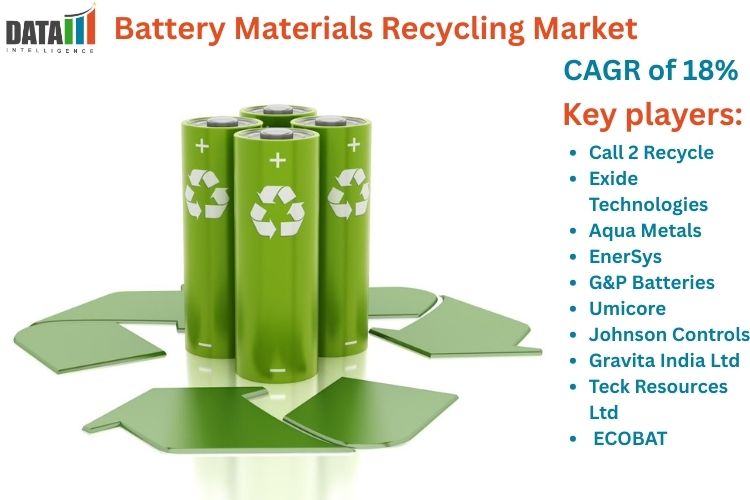
Battery Materials Recycling Market
The Battery Materials Recycling Market is expected to grow at a CAGR of 18% during the forecasting period (2024-2031).
The Battery Materials Recycling Market accelerates sustainable energy transition by recovering critical metals, reducing mining dependence, and supporting circular economy growth.”
AUSTIN, TX, UNITED STATES, February 27, 2026 /EINPresswire.com/ -- Market Overview:— DataM Intelligence
The Battery Materials Recycling Market has emerged as a critical component of the global clean energy transition, driven by the rapid adoption of electric vehicles (EVs), renewable energy storage systems, and consumer electronics. As lithium-ion battery consumption increases worldwide, the need for sustainable disposal and recovery of valuable materials such as lithium, cobalt, nickel, and manganese has intensified. Recycling helps reduce environmental hazards associated with battery waste while ensuring a stable supply of critical raw materials, minimizing dependence on mining activities. Governments and industries are increasingly promoting circular economy practices, accelerating investments in advanced battery recycling technologies.
To Download Sample Report Here: https://www.datamintelligence.com/download-sample/battery-materials-recycling-market
Key growth drivers include expanding EV production, stringent environmental regulations, rising raw material costs, and growing awareness of sustainable resource management. The lithium-ion battery segment dominates the market due to its widespread use in electric mobility and portable electronics. Geographically, Asia-Pacific leads the market owing to strong battery manufacturing ecosystems, large EV adoption rates, and government-backed recycling initiatives in countries such as China, Japan, and South Korea.
Key Highlights from the Report:
Lithium-ion battery recycling accounts for the largest market share due to increasing EV deployment worldwide.
Asia-Pacific dominates the Battery Materials Recycling Market supported by strong manufacturing infrastructure.
Hydrometallurgical recycling technology is gaining traction due to higher material recovery efficiency.
Rising demand for critical metals like lithium and cobalt fuels recycling investments.
Automotive applications represent the fastest-growing end-user segment globally.
Strategic partnerships between battery manufacturers and recyclers are reshaping supply chains.
Market Segmentation:
The Battery Materials Recycling Market is segmented based on battery type, recycling process, material recovered, and end-user industry. By battery type, lithium-ion batteries represent the leading segment due to their extensive use in electric vehicles, grid storage solutions, smartphones, and laptops. Lead-acid batteries also contribute significantly to recycling volumes because of established collection networks and mature recycling processes. However, future growth is strongly tied to lithium-ion recycling as EV adoption accelerates globally.
Based on recycling technology, the market includes pyrometallurgical, hydrometallurgical, and direct recycling methods. Hydrometallurgical processes are increasingly preferred because they enable efficient recovery of lithium, nickel, and cobalt with lower emissions compared to traditional smelting techniques. Direct recycling technologies are also gaining interest as they preserve cathode structures, reducing processing costs and energy consumption.
In terms of recovered materials, lithium, cobalt, nickel, manganese, and graphite represent key revenue-generating categories. Among these, cobalt and nickel recovery remains economically attractive due to their high market value and supply constraints. The automotive sector dominates end-user segmentation, followed by consumer electronics and energy storage systems. Increasing deployment of renewable energy storage infrastructure further expands recycling demand across utility-scale applications.
Speak to Our Analyst and Get Customization in the report as per your requirements: https://www.datamintelligence.com/customize/battery-materials-recycling-market
Regional Insights:
Asia-Pacific holds the largest share of the Battery Materials Recycling Market, supported by the presence of major battery manufacturers and EV production hubs. China remains a global leader due to stringent battery disposal regulations and government incentives encouraging recycling infrastructure development. Japan and South Korea continue to invest heavily in next-generation recycling technologies to secure critical mineral supply chains.
North America represents a rapidly expanding regional market driven by growing EV adoption and supportive government policies promoting domestic battery supply chains. The United States is witnessing increased investments in recycling facilities aimed at reducing dependence on imported battery materials and strengthening sustainable manufacturing ecosystems.
Europe is another prominent region experiencing strong growth due to strict environmental legislation and ambitious carbon neutrality targets. The European Union’s battery regulations mandate recycling efficiency and material recovery targets, encouraging automakers and recyclers to collaborate. Meanwhile, emerging markets in Latin America and the Middle East & Africa are gradually entering the recycling landscape as battery consumption increases alongside renewable energy expansion.
Market Dynamics:
Market Drivers
The primary driver of the Battery Materials Recycling Market is the exponential growth of electric vehicles worldwide. As EV batteries reach end-of-life stages, recycling becomes essential to manage waste sustainably while recovering scarce raw materials. Rising prices of lithium, cobalt, and nickel have further encouraged manufacturers to adopt recycling solutions as a cost-effective alternative to mining. Additionally, government regulations focused on reducing carbon emissions and hazardous waste disposal are compelling industries to invest in recycling infrastructure.
Market Restraints
Despite strong growth prospects, the market faces several challenges, including high initial capital investment required for recycling facilities and technological complexities associated with battery disassembly and material separation. Variations in battery chemistries and designs make standardized recycling processes difficult. Limited collection networks in developing economies and safety concerns related to battery handling also restrict large-scale recycling adoption.
Market Opportunities
Significant opportunities exist in the development of advanced recycling technologies such as direct cathode recycling and AI-enabled sorting systems. The emergence of second-life battery applications for energy storage creates additional revenue streams before recycling processes begin. Strategic collaborations between automakers, battery manufacturers, and recycling companies are expected to strengthen closed-loop supply chains. Furthermore, increasing demand for sustainable manufacturing practices provides long-term growth potential for industry participants.
Looking For Full Report? Get it Here: https://www.datamintelligence.com/buy-now-page?report=battery-materials-recycling-market
Frequently Asked Questions (FAQs):
How big is the Global Battery Materials Recycling Market currently?
What is the projected growth rate of the Battery Materials Recycling Market through 2032?
Who are the key players operating in the global battery recycling industry?
Which region is expected to dominate the Battery Materials Recycling Market during the forecast period?
What factors are driving demand in the lithium-ion battery recycling market?
Company Insights:
Key companies operating in the Battery Materials Recycling Market include:
Call 2 Recycle
Exide Technologies
Aqua Metals
EnerSys
G&P Batteries
Umicore
Johnson Controls
Gravita India Ltd
Teck Resources Ltd
ECOBAT
Recent Developments:
United States:
December 2025: Federal incentives expanded for battery recycling infrastructure, spurring new facilities to handle projected 2026 waste from consumer electronics and vehicles.
November 2025: Toyota and LG Energy Solution launched a joint battery recycling venture focused on recovering critical materials like lithium and cobalt from end-of-life EV batteries, strengthening U.S. circular economy efforts.
October 2025: U.S. tariffs on processed battery materials from key suppliers like South Korea and Belgium disrupted recycling supply chains, reducing availability of reclaimed lithium and cobalt for domestic EV production.
September 2025: Major investments flowed into advanced hydrometallurgical recycling plants in the Midwest, targeting higher recovery rates for nickel and cobalt amid rising EV battery waste volumes.
Japan:
December 2025: Government regulations tightened on battery disposal, mandating higher recycling quotas and boosting investments in AI-driven sorting technologies for better material recovery.
November 2025: Sumitomo Metal Mining (SMM) accelerated construction of its Li-ion battery recycling plant in Ehime Prefecture, set for operations in 2026, with partnerships for used battery collection.
October 2025: Japan initiated a national lithium battery recycling program to reclaim essential resources like lithium and cobalt, aligning with circular economy targets amid surging EV and electronics demand.
September 2025: Innovations in pyrometallurgical processes achieved over 90% recovery rates for cobalt and nickel, exceeding upcoming EU standards and enhancing Japan's export potential for recycled materials.
Unlock 360° Market Intelligence with DataM Subscription Services: https://www.datamintelligence.com/reports-subscription
Conclusion:
The Battery Materials Recycling Market is positioned as a cornerstone of the global energy transition, supporting sustainable electrification and resource conservation. Rising electric vehicle adoption, regulatory pressure, and increasing scarcity of critical battery metals are driving strong market expansion. With technological advancements improving recovery efficiency and economic viability, recycling is evolving from waste management into a strategic resource recovery industry. As governments and corporations continue to prioritize circular economy initiatives, the market is expected to witness sustained growth, innovation, and global investment throughout the forecast period.
Related Reports:
Battery Energy Storage System Market
Secondary Battery Market
Sai Kiran
DataM Intelligence 4Market Research
+1 877-441-4866
Sai.k@datamintelligence.com
Visit us on social media:
LinkedIn
X
Legal Disclaimer:
EIN Presswire provides this news content "as is" without warranty of any kind. We do not accept any responsibility or liability for the accuracy, content, images, videos, licenses, completeness, legality, or reliability of the information contained in this article. If you have any complaints or copyright issues related to this article, kindly contact the author above.
